Anna Tsouhlarakis at the lectern delivering the Yale School of Art’s 2026 commencement address. Photo by Pat Garcia, Photography MFA ‘24.
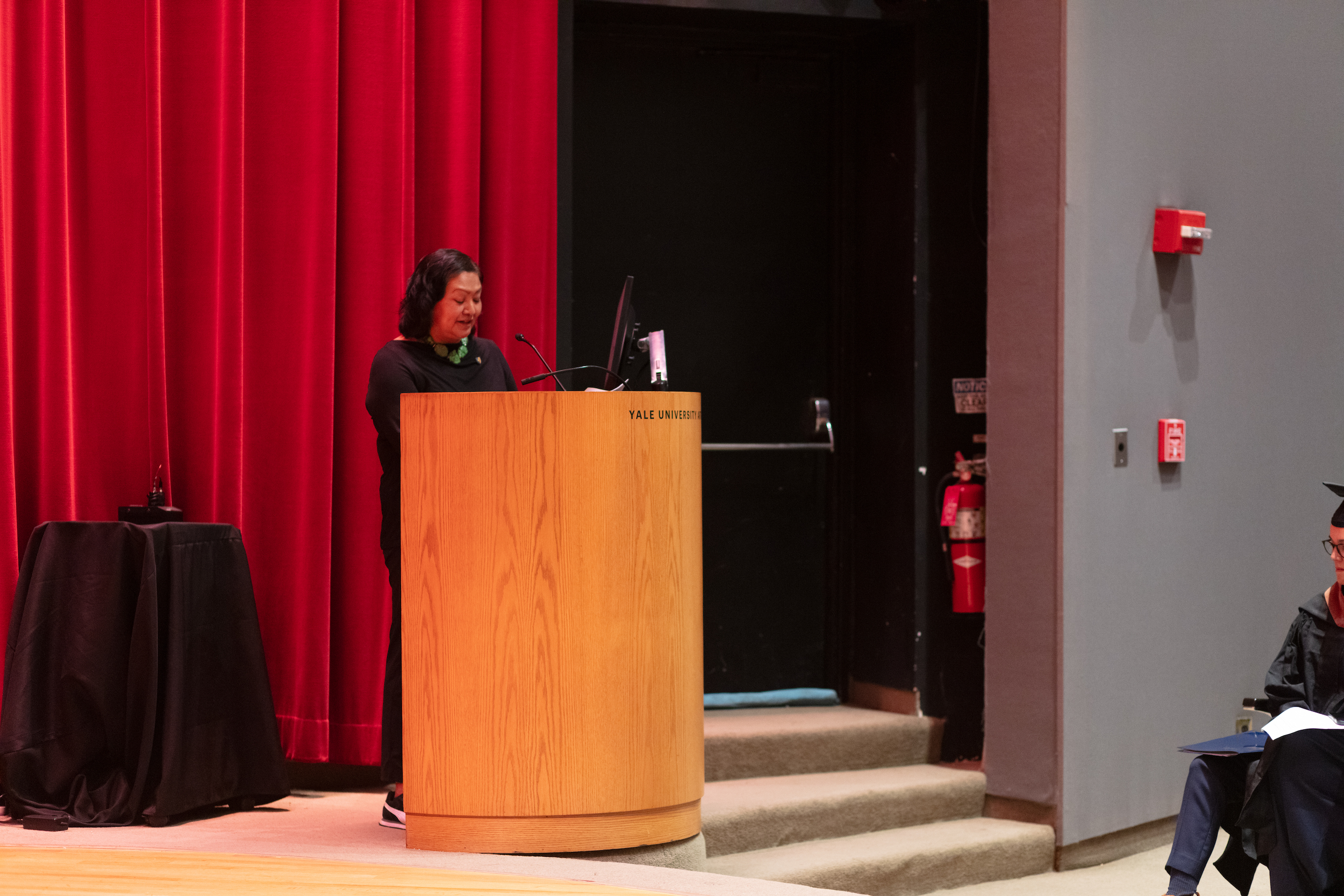
The Yale School of Art is pleased to announce that the full text of this year's commencement address is available to read online, below.
This address was delivered by theorist and artist Anna Tsouhlarakis, Sculpture MFA '02 on Monday, May 18, 2026 at the Yale School of Art's 2026 commencement exercises in the Yale University Art Gallery's Lecture Hall.
Thank you, thanks for having me.
About a month ago I visited my local Target in Boulder, Colorado. As I walked to the front of the store, a man started yelling and I realized he was yelling at me. He then yelled, “What?! You don’t speak English?!” I didn’t respond, he yelled again, “Why don’t you go back to where you came from?!” I stopped in my tracks. My response was not subtle. I emphasized that I’m Native American utilizing some colorful language—I’m not known to take slights, lightly. Other words were exchanged and I called 911 as I entered the store. Many people came to my aid and offered words of welcome to the community, of reassurance of my presence, and offered of safety if I needed someone to walk me back to my car. While all of this happened around me, my own mind rested, not in the horror of the moment, but in the awful hilarious irony of what just happened. And how this man could not have chosen a more willing adversary.
I think back to when I was young and when things like this happened, and I realize I never had a calm response. My reactions were always full of rage and of the desire to make people sorry that they decided to make random and unprovoked comments in my direction. I know now that this attribute comes from my father—a man who is half Navajo and half Greek. While his coloring bends more Navajo, his sharpness of tongue and the bruteness of his fists were born in the Mediterranean.
When I was living in London in the late 2000s, I read the book Outliers by Malcolm Gladwell. It’s about how people that we think of as the “greats” or “geniuses,” got to where they were, not necessarily because of some innate talent, but often because of practice and opportunity—being in the right place at the right time—and everything that led to those specific moments. I still think back to the book quite a bit. It made me reflect on how this goofy Navajo/Greek girl born in Kansas ended up living abroad and teaching in the homeland of colonialism.
I think about the stories of my grandparents and my father as well and how they add up to who I am today. My grandfather killed a Turkish soldier in Crete and had to flee Greece as a result. He landed in New York, was a hitman for the Italian mafia, and made his way West where he opened a Greek diner in Gallup, New Mexico. There he met a young Navajo woman nearly 30 years his junior. She was the spitfire of her family—the only one to go to Indian boarding school across the country, return home, and find work in the city. Her parents and many of her siblings were still monolingual Navajo speakers. She was drawn to new people, new ideas, and new experiences. She was a waitress at the diner and married my Greek grandfather. Their oldest child is my father.
I didn’t have to wonder too hard to realize that my longing for adventure comes down a direct line, and that I come from people that don’t easily put up with bullshit.
I was raised by a single father and his mother. From my grandmother, I was always reminded of the Navajo taboos that abound as you move throughout life—don’t whistle at night, don’t look at owls, don’t stare into a fire, and so on. She would speak to me in both English and Navajo. Many times, there were phrases or words I didn’t understand. I would ask for clarification or a direct translation into English. That was the worst thing to do. She would quickly lose her temper and get mad at me because many Navajo words don’t have direct translations. The word “Hózhó” or “beauty” is a good example. It seems like a simple enough word to translate, but it actually means balance, harmony, good, whole, and serene.
When I was in middle school, my grandmother was diagnosed with breast cancer. As I transitioned into high school she began succumbing to her illness. The silver lining of her decline was that she became more patient and more willing to “attempt” to explain larger Navajo concepts to me in English.
At 15, I had a writing assignment, and I wanted to write about my middle name, my Navajo name—Haniba. I went to my grandmother’s bedside and asked her about where it came from and more specifically about the meaning. Luckily, we were in the “patient” phase of my grandmother’s life and so she explained—nearly all traditional female Navajo names end in “bah”. Many younger Navajo women think it means “woman warrior.” But what it actually denotes is that you went through something and the rest of the name indicates how you went through it. My name roughly means I went under, waited, and came out on the other side. While this is the easiest way to translate it, there are other conceptual parts to it that are examples of the insane dynamics of the Navajo language.
As I’ve gotten older and have become a working artist, I continue to come back to these lessons of translation. I think about how the language is changing and how newer generations will have a new dialect, a diPerent understanding. I see this evolution of new dialects in art as well. My father is an artist, more traditional and craft-based than I am. But I’ve taken what he’s taught me and stretched it into sculpture, installation, performance, and video. It’s a language he’s not fluent in but one he can understand in parts, and he grasps the overall gist. As I work in my studio, I realize that’s what we’re all doing—creating new dialects of artmaking.
For me, finding my practice was figuring both what I wanted to share about my background, my culture, my experiences, and also what was sacred. As a Native person, many people expect me to educate them or to bring ceremony and sacredness into an art space. If you know anything about me—I don’t do that. I was taught that there is a time and place for those things, that some things are to share and other things are to hold close and protect. Figuring out your non-negotiables is important — and in fact imperative — in this line of work. Knowing what I didn’t want to share, helped shape what I wanted to focus on in my work and what I wanted to question and poke at. I came to realize that the dialect of art that I was creating was motivated by humor, absurdity, and reworking understandings of predetermined aesthetics in Native art.
In her new book How It Feels to Be Alive, Megan O’Grady writes about how art has been part of her life and helped her reflect on key moments. In the introduction she observes:
“[Art is] An estrangement, however subtle or extreme, that allows us to apprehend the world anew: this is one of art’s great strategies. By distancing us from the expected, art proposes alternative perspectives on what is beautiful or worthy of attention through the pleasure of visual surprise. It provokes unanswerable questions about how to live in a fragmenting society.”
What I love here is the mention of the unexpected, the alternative perspective. That is your voice now, and I want you always to remember to use it well. Speak up when it’s needed, not only when it’s comfortable, but also when it must be used. Let people in distress know they are not alone and let loud small-minded people know they will not prevail. Look over your shoulder at those who came before you and helped you get to where you are. Be grateful, of course, but also remember to continue on your path with pride and determination. People believe in you and your voice. Probably many more people than you’ll ever even realize. Use it with confidence.
One last thing I hope to leave with you - is that you are writing your own story now. Yale University, Yale School of Art, has a long and “prestigious” history. You can love it, you can hate it, you can critique it. But now, no matter what, you are the one writing that history. You are the author of where this story will go. For better or worse, your voice has new power, and this is your time to contribute to what this institution is known for, to what it can become. This is your time to decide the trajectory of art history, of artmaking, and how these things can become more full, more vibrant, and more true. You are the creators and makers of our time and I’m so proud to be able to spend even a moment with you all. As my grandmother would say— Hózhó Náhásdlįįʼ —go in beauty. Beauty is before you, beauty is behind you, beauty is above you, beauty is below you, beauty is all around.
— Anna Tsouhlarakis